How Facial Age Estimation Actually Works in Practice
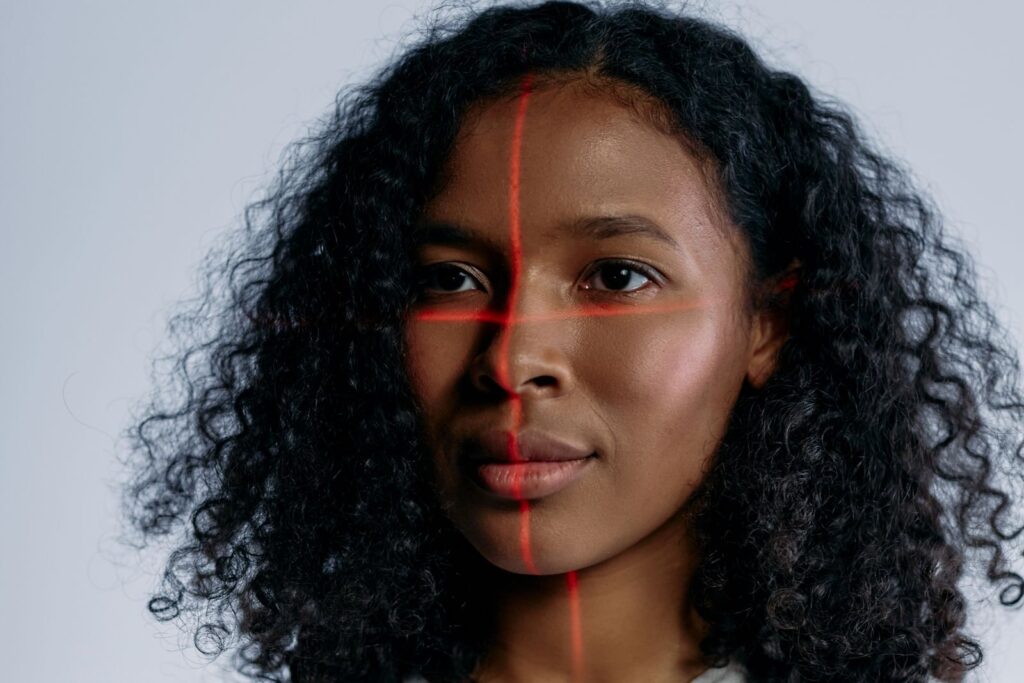
An age estimator does not count years. It compares one face with patterns drawn from a large set of labelled faces and returns the age those faces were said to be. The work happens in three stages, and each stage can lose information or add a small error. Knowing the stages explains why the answer arrives as a number in years, and why that number deserves a wide margin.
Follow a single portrait through the pipeline: one face, decent light, a recent phone. The system finds the face, straightens it, turns it into a list of numbers, and maps that list onto an age. By the end it has discarded the background, the colour balance, most of the resolution, and everything about you that is not visible on your skin.
Stage one: find the face
Detection is a search. The model scans the image at several sizes and proposes rectangles that probably contain a face, each with a confidence score. It keeps the best one, or the largest one when several people are in frame. Landmarks come next: five points for the eyes, nose and mouth corners, or sixty-eight when the system wants the jawline, brows and eyelids as well.
This stage fails in ordinary ways. A profile, a hand across the cheek, sunglasses, a face turned into shadow, a head that occupies forty pixels of a group shot, or motion blur can all produce a weak detection. Detectors are trained on photographs, so they inherit the habits of those photographs, and performance varies with pose, lighting and skin tone. When detection is uncertain, everything downstream is built on a bad crop.
Stage two: straighten, crop, and describe
Alignment rotates, scales and shifts the crop until the eyes sit at fixed coordinates. Some systems also fit a three-dimensional model of a face and re-render it towards a frontal view. This removes tilt and roll, but it cannot invent the far side of a face turned away from the camera, and residual pose error survives.
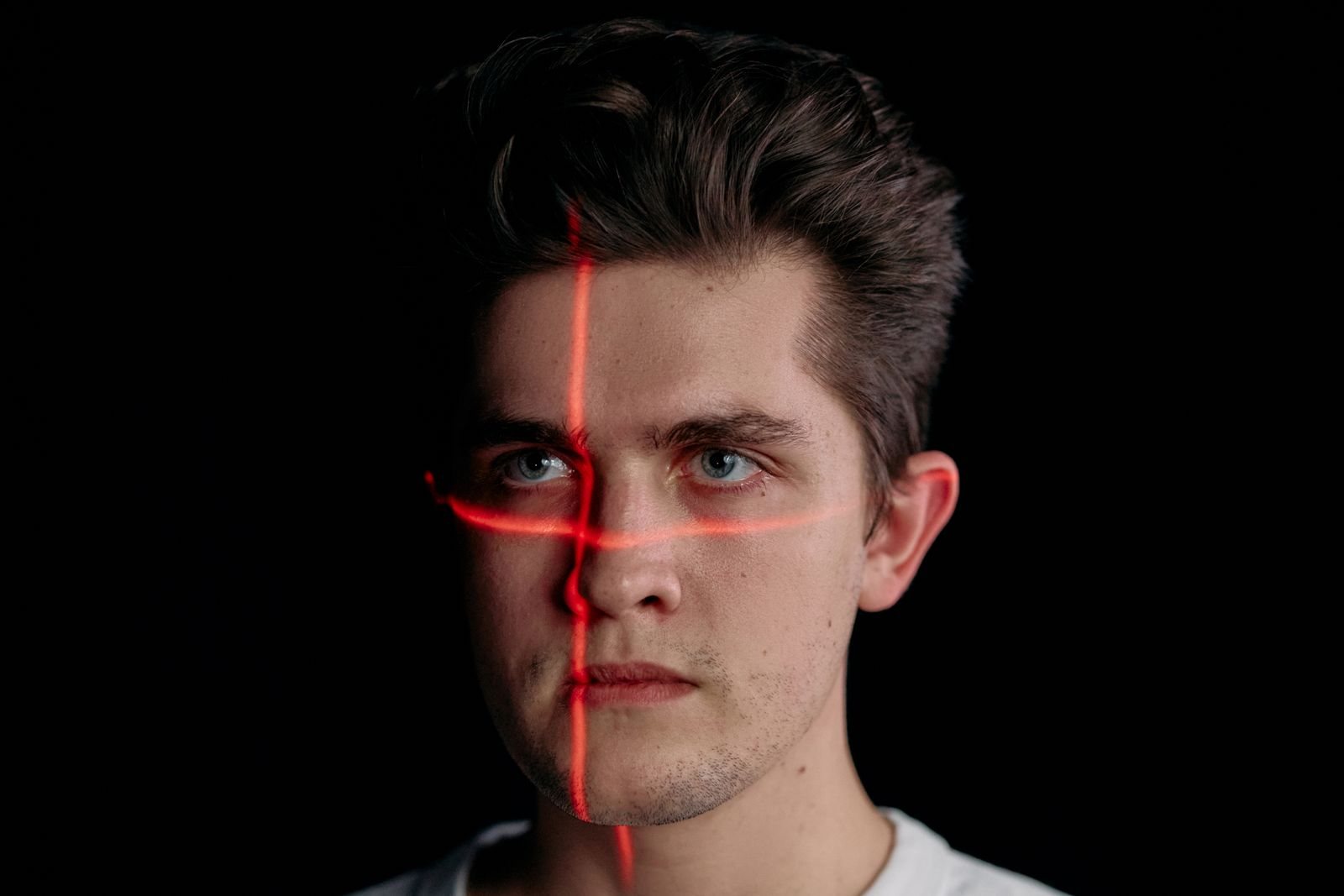
The aligned crop then goes through a convolutional network. Early layers respond to edges and colour transitions, middle layers to texture and parts such as an eye or a nostril, deeper layers to how those parts sit together. The last layer produces an embedding: a long list of numbers, often hundreds or thousands of them, that places the face at a point in a mathematical space. Faces that look alike land near each other.
That embedding is the part worth noticing. It is the same kind of representation used in face recognition, and in some ways it is more identifying than the original pixels. Whether it is built on your phone or on a server is a design choice with privacy consequences, and a fair question to ask before uploading. Rules are arriving at different speeds: the European Commission’s AI Act page describes a risk-based framework with extra duties for certain biometric systems, applied in stages rather than all at once.
Stage three: from a description to a number
Two output designs are common. A regression head is trained to produce a single value, adjusting its weights until the average gap between prediction and label shrinks. A classification head instead spreads probability across age bands, for example five-year bins, then reports either the most likely bin or a weighted average of the bin centres.
That weighted average is where decimals come from. A tool that answers 34.6 has not measured your age to a tenth of a year. It has produced a distribution over bins and taken its centre of mass, which is a summary of a guess rather than a measurement. Some research systems return the whole distribution, where width signals doubt. Consumer tools usually hide the spread and show only the centre.
Many production systems also average several predictions for the same face: the original crop, a flipped copy, and a slightly resized one. Averaging reduces jitter between uploads, but it does not remove bias, and it hides how much the individual predictions disagreed with each other.
Why ranking is easier than counting
Absolute age is hard because appearance and calendar age drift apart. Sun, sleep, smoking, weight change and genetics all move the surface of a face without moving the birth date. A model trained on photographs learns the average relationship in its training set, then applies that average to you.
Relative judgements are easier. Deciding that one face looks older than another uses the same embedding with a simpler question, and systems tend to be more consistent at ordering faces than at naming a year. The usual summary statistic is mean absolute error, the average size of the miss, ignoring direction. Suppose a system reports four years. On its test set, guesses were four years off on average, some high and some low. A face in unusual light can miss by far more, and the reported figure is an average rather than a cap.
Labels are the other weak point. A dataset built from public figures with documented birth dates has clean ages but a narrow slice of people. A dataset built from human guesses records apparent age instead, which is a different target. Neither is wrong, but a model can only learn what its labels define, which is why two tools disagree about the same face. NIST’s face recognition evaluations, which test a related set of algorithms, have measured how accuracy varies with demographic group and image quality; age models trained on uneven photo collections inherit similar risks.
Using one without over-reading it
Feed it one clear face in even light, and read the answer as a band of a few years rather than a point. Check what the tool claims to predict: apparent age from a photograph, or a birth date. Those are different products.
- Use a recent, unedited photo with one face in frame.
- Run a second photo in different light and see how far the two results drift.
- Ignore decimals and single outliers.
- Do not use the output to infer health, fertility or identity.
- Check where the processing happens before uploading a face that is not yours to share.
The site’s how old do I look tool runs this kind of pipeline and returns an estimate you can compare against a second photo. If what you want is your age in days, the age calculator answers a question that has an exact answer. The gap between the two numbers is not a measure of how well you have aged; it is the difference between a count and a guess.
FAQ
What does mean absolute error mean in plain language?
It is the average distance between the guess and the true age, counted without plus or minus signs. A four-year figure means the typical miss was four years, and it says nothing about the worst case.
Why does the tool show a decimal?
Because the number came from averaging a spread of possible ages. The decimal is arithmetic, not precision, and the last digit carries no information about you.
Is age estimation the same as face recognition?
No, but they share machinery. Recognition asks who this is; estimation asks how old this appears. Both turn a face into a numerical description, which is why the privacy questions overlap.
Can it estimate a child’s age accurately?
Less reliably. Faces change quickly in childhood, and the visible difference between adjacent years is small. Treat any estimate for a child as a rough impression.
Last updated: October 26, 2026. This article is for general information only and is not medical, veterinary or legal advice. For decisions about your own health, your pet, or a legal matter, consult a qualified professional.
Sources
- National Institute of Standards and Technology, Face Recognition Vendor Test (FRVT): nist.gov
- European Commission, AI Act: ec.europa.eu